
Imagine a month where nearly two billion people worldwide come together to reflect, fast and celebrate faith. It’s the month when the Quran, the holy book of Islam, was first revealed. To honor this divine month, Muslims fast during daylight hours. Ramadan is not just a religious obligation but a spiritual journey that unites Muslims across cultures and continents. But what exactly is Ramadan, and why is it so significant?
Ramadan is the ninth month of the Islamic calendar, considered the holiest month for Muslims. It is a time of fasting from dawn to sunset, prayer, self-reflection and increased devotion to God. The month is observed as a commemoration of the first revelation of the Quran to Prophet Muhammad (SAW).
Many people might not realize the fascinating history behind Ramadan. Exploring its origins helps us appreciate why it holds such deep spiritual and cultural significance for Muslims today.
Ramadan is the month in which the first revelation of the Quran was sent down, marking the beginning of divine guidance for humanity. Fasting during this month was introduced in the second year of Hijrah (624 CE) through Quranic verses, particularly Surah Al-Baqarah (2:183-185). In this passage, Allah says:
“O you who have believed, fasting is prescribed for you as it was prescribed for those before you, so that you may become righteous.”
Ramadan, a significant month in the Islamic calendar, has deep historical roots, as it was also part of the ancient Arabian calendar. The name Ramadan originates from the Arabic term “ar-ramad,” meaning scorching heat, symbolizing spiritual purification.
Muslims believe that in A.D. 610, the angel Jibril appeared to Prophet Muhammad and revealed the Quran, Islam’s holy scripture. This divine event, known as Laylat Al-Qadr or the “Night of Power,” is believed to have taken place during Ramadan. To honor this sacred revelation, Muslims observe fasting (sawm) throughout the month.
The Quran, comprising 114 chapters, is regarded as the direct word of Allah (God). It is complemented by the hadith, which document the thoughts and actions of Prophet Muhammad as narrated by his companions. Together, these texts shape the foundation of Islamic teachings.
Fasting during Ramadan serves as a spiritual shield, guiding Muslims to exercise self-discipline and restraint. A well-known saying from Saheeh Al-Bukhari states:
“Fasting is a shield, so the one who fasts should refrain from obscene speech and ignorant behavior. If someone provokes or insults him, he should simply respond: ‘I am fasting. I am fasting.’”
This powerful message highlights the essence of Ramadan fasting—not just abstaining from food and drink but also practicing self-control, patience, and kindness.
Yes, but what makes it significant to Muslims worldwide? Fasting during Ramadan is one of the Five Pillars of Islam, making it a core practice for all Muslims. Every Muslim who has reached puberty and is in good health is required to fast each year during this holy month.
During Ramadan, Muslims focus on strengthening their connection with Allah (God) by reading and reflecting on the Qur’an, improving their character, helping those in need and seeking forgiveness for their mistakes.
A saying (Hadith) from Prophet Muhammad (SAW) highlights the special reward for fasting: Allah says, “Fasting is for Me, and I will reward it.” (Hadith | Muslim)
The final days of Ramadan, often called the “last Ashra,” hold immense significance as they offer a golden opportunity for believers to seek forgiveness, redemption and salvation from the Hellfire. These blessed nights are made even more virtuous by the presence of Laylat al-Qadr, the Night of Decree, about which the Prophet Muhammad (SAW) said:
“Whoever stands (in prayer) on Laylat al-Qadr with faith and hope for reward, all their past sins will be forgiven.” (Agreed upon)
When Aishah (RA) asked the Prophet (SAW) about the best dua to recite on this special night, he taught her:
اللَّهُمَّ إِنَّكَ عَفُوٌّ كَرِيمٌ تُحِبُّ الْعَفْوَ فَاعْفُ عَنِّي
“Allahumma innaka Afuwwun [Karimun] tuhibbul afwa fafu annee.”
(O Allah, indeed You are Pardoning and Generous; You love to pardon, so pardon me.) [Tirmidhi: 3513]
As the holy month draws to a close, it’s also the perfect time to increase our sadaqah (charity), following the noble example of the Prophet (SAW), whose generosity in Ramadan was described as being “faster than the wind.”
Read here to gain a deeper understanding of the significance of the last ten nights of Ramadan.
While fasting is obligatory for most Muslims, there are certain groups who are exempt, including:
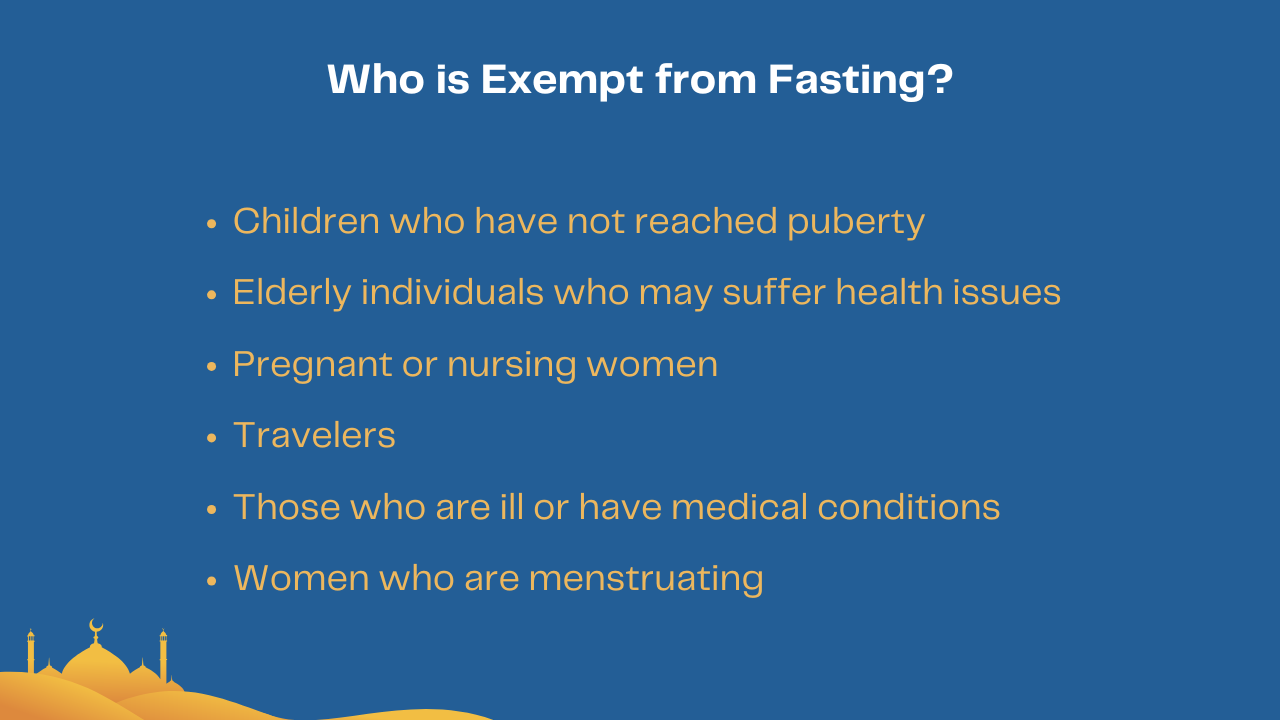
For those who cannot fast due to valid reasons, alternative acts such as feeding the needy can be performed as compensation.
Why does Ramadan start on a different day every year?
Can non-Muslims participate in Ramadan?
How can non-Muslims show support during Ramadan?
When should I state my intentions (niyyah) for the fast?
Do I have to renew my intention to fast every night?
Does vomiting break my fast?
How soon must I make up for missed fasts?